skip to main |
skip to sidebar
 The Summer Before the War by Helen Simonson
My rating: 4 of 5 stars
The Summer Before the War by Helen Simonson
My rating: 4 of 5 stars
How controversial is a Latin teacher named Beatrice? In 1914, in the small English town of Rye, a woman teaching Latin is shocking. Shocking! Beatrice Nash, who was her scholarly father's assistant, travel agent, and budget manager until his death, has two choices: remain at her stingy and disapproving aunt's house, or work. She chooses work.
Rye, although its more titled and tony citizens are conservative and easily shocked, has undercurrents of sophistication and modernity that Beatrice taps into immediately. She meets a serious surgical student, Hugh, and his flamboyant, poetic cousin, Daniel, both watched over and protected by their aunt Agatha. Her students include Snout, a Romany boy whose innate talent for Latin is suspect in his own community and the outside. Circumstances also bring her into the circle of notable residents, including a freethinking woman photographer, a novelist whose entry into social circles is blocked because of a divorce in her past, and a portly, portentous novelist who clearly is styled on Henry James.
The peaceful summer is the prequel to England's entry into the War. Many local men are called to fight in the bloody trenches, hospitals, or officer corps. How the townspeople adjust depends not only on their wealth, title, and status, but also the emotional toll of expectations and loss.
What will the dreamy Daniel do when his partner-in-poetry, Craigmore, is forced to enlist when his father hears Daniel's scandalous poem about his son? What of Snout, who realizes that his Romany heritage will mean that he will never have the opportunity to use his scholarship? And how will the haughty townspeople react to the hoardes of Belgian refugees they are forced to take in?
The gentry set up super-patriotic organizations, including a chapter of the St. George Recruitment Brigade, in which fetchingly-dressed young women pressure young men to enlist, handing those who resist a white feather, symbol of cowardice. They also plan a parade and exhibition, including Daniel's model trench, tastefully decorated and supplied with shelves for books of poetry. Marrows are judged, young people pick hops and dance, students translate the Aenid before they march off to war. So it goes.
The texture of life in Rye changes with some room for growth and tolerance, and with tragedies mixed in with the small but vital victories, both personal and political. As in Simonson's first book, Major Pettigrew's Last Stand, the reader gets to know this texture, and comes to care about - and root for - the townspeople and the town.
Highly recommended. One star subtracted because the ending seemed disappointingly hasty.
I received this book as an ARC from NetGalley in exchange for a fair review.
View all my reviews
 Journey to Munich by Jacqueline Winspear
My rating: 5 of 5 stars
Journey to Munich by Jacqueline Winspear
My rating: 5 of 5 stars
Maisie Dobbs is one of the most complex characters I've followed in any fictional series, regardless of genre. In this book, the reader follows her as she accepts a request to go to Munich to rescue a British industrialist who has been imprisoned in Dachau for two years. She is still trying to process the tragedies that befell her in the last book, she has no permanent home in London, she has no profession, and she has suffered so many losses that even the lessons she learned from her beloved mentor, Maurice, do not seem to center her. Never the less, she accepts the challenge.
Once in Munich, she learns that Hitler is about to launch his incursion into Austria, Jewish and Christian children have to hide if they wish to play together, and citizens can be tortured if they fail to reply to soldiers' salutes to the Fuhrer. She also begins to apply the meditation and visualization techniques that strengthen her resolve and her soul. She will need all the strength she can muster to find the industrialist, fulfill a promise to a grieving mother, and pull her life back together once this trial is over.
I admire Maisie Dobbs for her courage, honesty, and willingness to be open to reality, regardless of where it leads her. I admire Jacqueline Winspear more, of course, for having the breadth of imagination and skill to bring this character to life.
I received an ARC of this book from Eidelweiss. This is an honest review.
View all my reviews
 Devonshire Scream by Laura Childs
My rating: 4 of 5 stars
Devonshire Scream by Laura Childs
My rating: 4 of 5 stars
Another delicious, fragrant tea shop mystery? Yes, of course! This time, Theo is catering a glittering jewelry show in her friend's store when a gang of ruthless thieves break through the windows and glass cases. Not only do the jewels get nabbed, but her friend's young niece is killed by a deadly shard. Over the next few days, Theo's sleuthing reveals many suspects, from wealthy yacht-owners to literary outliers. Will she be able to help nab the guilty without endangering herself or her friends?
She also gets to serve up some truly splendid-sounding theme teas. Don't try to read this book unless you have a steady supply of hot, aromatic tea and nibbles handy.
I took off one star because of a bit of haphazard characterization that really doesn't impact the story, but proved a little distracting.
Thank you, NetGalley, for the ARC. This is a fair review.
View all my reviews
 Knitlandia: A Knitter Sees the World by Clara Parkes
My rating: 5 of 5 stars
Knitlandia: A Knitter Sees the World by Clara Parkes
My rating: 5 of 5 stars
Clara Parkes, whose first subject as a professional writer was travel, takes us on a tour of knitting and fiber festivals. Some of her adventures as a yarn evangelist are set in venues that thousands of knitters have shared -- Rhinebeck, Taos, Scotland, Portland, Maryland. Some tell background stories of festivals and events we dream of attending - Squam, TNNA, Vogue Knitting Live, Madrona. We are there at Sock Summit for the first knitting flash mob, we are in Denver to film "Knitting Daily" (as she is encased in makeup that makes her feel "like Ronald MacDonald in drag," and we go along on a tour of sheep-intensive Iceland. Always, there is pho, her comfort food, and yarn, in all of its incarnations and manifestations.
My favorite moments are in Paris, where she breaks a promise (no yarn! just family!) and visits a petting zoo of a shop" that offers yarn and tea. Years before, she tells us, she fell in love with fountain pens in Paris. How can anyone not be delighted with this book?
Thanks to NetGalley for the review copy in exchange for a fair review.
View all my reviews
Be sure and visit me at my main blog, Tea Leaves, where I write about life, liberty, and knitting - and the occasional book...
 No Cats Allowed by Miranda James
My rating: 5 of 5 stars
No Cats Allowed by Miranda James
My rating: 5 of 5 stars
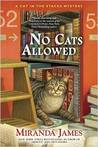
Librarian Charlie Harris and his insanely huge large Maine Coon cat, Diesel (so named for the quality of his purring) are trying to be civil to the interim library director, but he's such a conniving, foul creature that even the ever-affectionate feline can't abide him. The feeling is mutual, as Charlie learns when the mean man bans his cat from the library, fires people without warning or reason, and acts as if he is out to change the workplace into a gulag.
If only those were the only problems facing the pair! The cat-hating ogre creep is killed in a uniquely library manner, to no one's real surprise or dismay, but the clues are pointing to Charlie's friend Melba instead of - well, instead of to whom?
I've loved each of the "Cat in the Stacks" mysteries for their humor, cheerful depiction of small-town habitues, and - of course - the wonderful, vocal Diesel. Librarians will love the spot-on depictions of behind-the-stacks goings-on. Recommended to anyone who loves well-written mystery series.
I was given an ARC of this book for review by NetGalley.
View all my reviews
 Knitting Pearls: Writers Writing About Knitting by Ann Hood
My rating: 3 of 5 stars
Knitting Pearls: Writers Writing About Knitting by Ann Hood
My rating: 3 of 5 stars
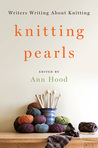
Knitters, in my experience, are readers as well. We don't just read about knitting, although many famous knitters are also writers who write about knitting. Perhaps I generalize, but I believe that a collection of essays about knitting is designed to appeal mainly to knitters, since the editor will expect us to identify and empathize with them.
With a few exceptions, this collection will satisfy. Those exceptions are essays in which knitting is so tangential to the essay that one wonders why they were included, or in which the author calls knitters and knitting "...a chew-gum-and-walk-at-the-same-time crowd and an occupation ideal for a zombie. What does he know?
Some examples of excellence:
-- Anne Bartlett, whose growth as a knitter and novelist includes designing an intarsia version of a Scott Joplin rag while editing a book about former cannibals. (Former!)
-- Jared Flood, whose father gives him an old, iconic sweater knitted by his mother, "a veritable Swiss Army knife" of crafting.
-- Clara Parkes, who sees her UFOs* and calls them "beautiful limerence of our first few rows rows together... my personal museum of optimism." (*for the muggles, UFOs are unfinished objects.)
-- Diana Gabaldon, who says "everything you experience forms you as a writer. Why should knitting be an exception?"
Those who do not knit have insights, too - Jane Hamilton, for example, who lives on a sheep form, but chooses not to knit the beautiful, soft yarn milled from her flock. She lived for one summer with the last authentic creator of Harris Tweed, Miss Campbell. There, in the Outer Hebrides, she scraped lichen for dyes while the old woman spun and wove, selling fabric from her kitchen. Hamilton even knitted a scarf, but only because she was cut off from her family except for aerogrammes, deprived of radio and television, and forbidden by Miss Campbell to read. The scarf turned out so "...alarming that probably in this day and age TSA would shut the place down" when she discarded the thing at the airport. A novel is a miracle, she writes, and she has chosen "the miracle of language, the texture and song of speech... so absent on the heath" for her own life's work, her own material.
The book disappoints in two important ways. The first: it is arranged alphabetically by author, not by theme, and thus seems haphazard. The second: what were they thinking? Including six knitting patterns without even line drawings to tempt the reader to try them?
Recommended, in small doses, for knitters and for fans of the included authors.
I received this book from Goodreads, and this is a fair review.
View all my reviews
 Loving Eleanor
 by
Susan Wittig Albert
My rating: 5 of 5 stars
This book is excellent on so many levels! As fiction, it enchants, as reporter Lorena Hickock meets, loves, and mentors Eleanor Roosevelt, whose aversion to being a public persona is transformed - to the benefit of the United States, but not always those who love her. How much time and energy can one woman have?
Based on extensive research, including the enormous trove of letters between these two fascinating women, Loving Eleanor is a glimpse into the life of a pioneering woman journalist, and the times she reported on - including the most dire poverty of the Depression. Without Hick's advice, Eleanor would not have written the columns ("My Day") that endeared her to the masses. Without Hick's reporting (and company on trips to mining camps), Eleanor's understanding of how people were suffering would have been secondhand.
Some of the details in this book, such as the lives of people so poor they could only offer a bowl of tumbleweed soup to visitors, are so graphic that your heart will ache. Others, such as the gradual realization by Hick that the post-political idyll she wanted for herself and Eleanor will never happen, are heartbreaking in a very personal way.
I'm grateful to Albert for including endnotes and an extensive bibliography -- I want to learn more about both of these women, and their times.
Recommended. Thank you, NetGalley, for giving me an ARC to read and review.
View all my reviews
Be sure and visit me at my main blog, Tea Leaves, where I write about life, liberty, and knitting - and the occasional book...
 The Lake House by Kate Morton
My rating: 4 of 5 stars
The Lake House by Kate Morton
My rating: 4 of 5 stars
Past and present mingle and meet in two English houses. One, a huge and crumbling house on a lake, was where a baby boy disappeared during a gala Midsummer's Eve party in 1933. The other, a small home in Cornwall, is where a widower resides with the tangible and ineffable memories of his beloved wife.
Sadie Sparrow, a metropolitan detective, is visiting her grandfather, on leave from a case she took so personally that the violated protocol: the disappearance of a young mother, who abandoned her baby in a London flat. While taking a long run through a thick forest, she discovers Loeanneth in ruins, and decides to investigate. The locals have long memories and computer files that lead her to the lost baby's elderly sister in London, now a secretive and popular author of a long-running series of mysteries. She decides to allow Sadie to unlock the house, possibly to unlock the unsolved tragedy.
Both houses are presences, especially Loeanneth,which begins to reveal its secrets to the motivated detective and the reclusive writer. Letters, diaries, abandoned manuscripts, and the crumbling artifacts of passions spent lead Sadie deep into the secrets of a once-vibrant family, broken by wars and loss.
Except for the ending, which is a bit too tidy, this book is a splendid two-tiered tale, with homes that become characters in the spirit of Rebecca's Manderley and Howard's End.
4 1/2 stars.
I received an ARC of this book from NetGalley, and this is a fair review.
View all my reviews
 The Hours Count by Jillian Cantor
My rating: 3 of 5 stars
The Hours Count by Jillian Cantor
My rating: 3 of 5 stars
Whatever else you know about Ethel and Julius Rosenberg, one thing is true: they were the parents of two young sons. Julius had already been arrested when Ethel was called to testify before the Grand Jury on 11 August 1950. She was not given so much as a minute to make arrangements for the care of their two young sons when she was arrested immediately after testifying. One minute, she was a proper Jewish housewife and mother, wearing white gloves. The next minute, she was in custody, charged with typing her husband's notes. Whatever else you know, going into this book, realize this: ultimately, she was executed for typing. Not stealing or passing atomic secrets to the Russians. Typing.
The story is told by Millie Stein, a fictional neighbor in the apartment complex where the Rosenbergs last lived. Millie is married to Ed, a brutal Russian Jew, whose indifference to their son (probably autistic, lacking language skills) contrasts cruelly to the love and warmth in the Rosenberg family. Although Millie knows that her husband attends political - probably Communist - meetings, she is shocked to learn that he has known the Rosenbergs for years.
Ed grudgingly allows her to accept an invitation to a party at the Rosenbergs' apartment after she and Ethel become friendly, bonded by their children and shared concerns. Ethel has secretly steered Millie to Planned Parenthood for birth control, which would enrage Ed, who threatens to institutionalize their son unless she has another, "normal" child. Millie has kept secrets for Ethel to protect her privacy in the neighborhood.
Secrets are in the air at the party, where spying, lying, and politics are discussed by partygoers, including David Greenglass (Ethel's brother), his wife Ruth, and Morton Sobel, all of whom figure in the betrayal and death of the Rosenbergs. Millie also meets another (fictional) character there, a psychologist named Jake, whose promise to help her son develop language skills leads her down yet another dangerous, secret path.
Since the events that lead to the arrests, trials, and executions are only glimpsed by Millie, it can be frustrating to pick them out of the narrative. Both her husband and the therapist advance the plot without significantly enlightening the reader, since each has his own agenda, and the reader is as bewildered as Millie. Some of those glimpses are so ordinary, yet so meaningful - Julius playing with his son in the park, Ethel cooking a chicken. Others, just as true, are horrific, such as the government agents scooping evidence out of the apartment as Ethel pleads with them to spare the recording she had made of her voice, hoping they would know what she sounded like if she was gone.
Millie's plight as an abused woman who puts her trust in anyone who is kind to her and her son is vivid and heartbreaking, but her moments of clarity and insight into her husband's true business are made less believable by her ignorance of the world. Still, this detailed look at the last free days of the doomed couple is gripping and thought-provoking. The author provides a reading list. I care enough about the disquieting evidence of official malfeasance to learn more.
3 1/2 stars.
I received an ARC of this book from NetGalley; this is a fair review.
View all my reviews
 The Gilded Hour by Sara Donati
My rating: 5 of 5 stars
The Gilded Hour by Sara Donati
My rating: 5 of 5 stars
The gilded hour is that liminal time after the sun has set and before all the light has faded - a time to contemplate the day, and plan for the next. The Gilded Hour, set in 1883, illuminates the lives of intersecting families - a thoughtful but realistic police officer who is the son of Italian-Jewish immigrants, two women doctors - cousins - whose struggles to find acceptance and respect are complicated by love and the evil of ignorance, and four Italian orphans who are separated by forces that may be accepted in the eyes of society, but that do not stand up to loving scrutiny.
The sheer detail of this long, dense, vivid book is one of its joys. Nothing - not the last stages of the Brooklyn Bridge, the ferry rides to an unimaginably rural Staten Island, the splendor of the Vanderbilt mansions, the hideous squalor of the streets - is wasted; all of it brings you into the story, breathless and fearful, joyful and expectant. The two cousins, one a Free Woman of Color, struggle against the medical mainstream as well as the forces of Anthony Comstock, which would deny women even the most basic understanding of their bodies and choices. That they accomplish what the do is simply amazing. Even the recent national history is important, as choices made during the Civil War continue to resound through the lives of every New Yorker.
I wish there were more than five stars to award. I learned so much from this book, and I came to love the characters so much. It's going to be hard to wait for the next book in the series.
Thank you, Goodreads, for giving me a copy of this book in exchange for a fair review.
View all my reviews
 A Curious Beginning by Deanna Raybourn
My rating: 4 of 5 stars
A Curious Beginning by Deanna Raybourn
My rating: 4 of 5 stars
Veronica Speedwell is curious, indeed.
If you combine the scientific curiosity of Maisie Dobbs, the adventurous spirit of Beryl Markham, and the headstrong courage of Flavia de Luce, you won't come close to the vitality of Veronica Speedwell. This young woman has established herself as a world-class lepidopterist, travelling the globe with her butterfly net, a sharpened hatpin, and a carefully-packed carpetbag. She is alone, sure-footed, and satisfied.
As this novel opens, Veronica has attended the funeral of her guardian, and has scandalized the vicar's wife (whilst drinking tea, "properly strong... I abhorred weakness of any kind, but most particularly in my tea") and planned to embark on new adventures, both scientific and amatory. Her disinclination toward the traditional Victorian woman's life is extreme, and she pities the woman who tries to fix her up with a widower: "It is not your fault that you are entirely devoid of imagination," she tells the sputtering vicaress, "I blame your education." Indeed.
However, mysterious and nefarious forces have combined to snuff that idea, if not Veronica herself. In a matter of days, she is nearly abducted, thrown onto the unwilling protection of a handsome but surly natural scientist, and forced to flee London with the brilliant brute to join a travelling circus. Why do these evildoers want her? What is there about her background that makes her so dangerous? And does the mystery have anything to do with Queen Victoria's upcoming Golden Jubilee?
Veronica and Stoker (the brute) are such a well-matched and appealing couple that this new series will undoubtedly be thrilling and satisfying. I recommend Veronica's maiden voyage (as it were) to anyone who enjoys a cracking good time in the presence of thoroughly enjoyable characters.
I was given an ARC of this book by NetGalley in exchange for a fair review.
View all my reviews
 The Lemoncholy Life of Annie Aster by Scott Wilbanks
My rating: 5 of 5 stars
This book has everything that I love: magic, time-travel,letter-writing, unusual characters who find each other and form a loving little community, wit, intelligence, historical verisimilitude, and smatterings of quoted Tolkien.
The Lemoncholy Life of Annie Aster by Scott Wilbanks
My rating: 5 of 5 stars
This book has everything that I love: magic, time-travel,letter-writing, unusual characters who find each other and form a loving little community, wit, intelligence, historical verisimilitude, and smatterings of quoted Tolkien.
I often say "If you liked The Night Circus..." - I'll say it again.
Utterly delightful. I read it in two days, and will read it again.
Thank you, NetGalley, for the ARC. This is a fair (and exuberant) review.
View all my reviews
 The Swans of Fifth Avenue by Melanie Benjamin
My rating: 4 of 5 stars
The Swans of Fifth Avenue by Melanie Benjamin
My rating: 4 of 5 stars
Sometimes, even the wealthiest, most glamorous, most fêted superstar feels like a motherless child. Once Bobolink (Babe Paley) and True Heart (Truman Capote)were introduced, they were soulmates because their mothers, although present, were emotional bullies, leaving empty spaces and empty rooms that the socialite and the flamboyantly gay writer could fill with confidences and true vulnerability.
They met before Capote's success with Breakfast at Tiffany's. She and her husband welcomed him into their world and opened themselves to him even more than to each other - only Truman was allowed to see Babe's unpainted, scarred face. Not her husband, William Paley, nor CZ Guest, Slim Hawks, Gloria Guinness, Pamela Harrison, or any other the other glittering socialites had a clue about the renowned beauty's inner insecurities. From party to party, social event to lavish vacation, Truman and the Paleys partied and gossiped and lived the life of true excess that filled newspaper columns about the rich and famous.
How did it all go so wrong? After In Cold Blood, Truman faced a writer's block so deep that only excesses of drugs, alcohol, and Studio 54 could distract him. Although his beloved Babe was succumbing to lung cancer, he used the materials he had gathered - the gossip, innuendo, backstories - and exposed Babe and her circle in a story he published in "Esquire" - “La Côte Basque 1965” - destroying the illusion of their beautiful lives, and, effectively, committing social suicide.
Almost everyone in this book is seedy, gossipy, and unpleasant. Benjamin captures the rhythm of their language (especially Capote's) and the spectacle of their lives so well that you only realize afterwards that you have just read about truly awful people. The planning and execution of Capote's Black and White Ball are especially vivid, especially when the younger celebrities such as Mia Farrow and Penelope Tree leave with Frank Sinatra and the party collapses.
Four and 1/2 stars - close to completely enchanting.
I received this book as an e-ARC from NetGalley, and this is a fair review.
View all my reviews