8.28.08 I wrote this review after I read the book for the first time. I should write another review, since my second reading (for a book discussion ) changed my mind completely.
The Thirteenth Tale by Diane Setterfield is being flogged at Borders and Barnes & Noble as a must-read novel. I'm about to plunge into Gulliver's Travels for Knit the Classics (no longer in existence, R.I.P.), but I wanted a palate-cleanser, so to speak, so I brought the book home from the library and settled in with a cup of tea.
The strange thing, since the book is based on twinnage, is that my reading experience was Janus-like. My middle name is Jan. Maybe Jan is the mediator between the happy-to-have-read-this Janusface and the oh-come-on! Janusface?
The book utterly, totally engrossed me as I was reading. The book also utterly, totally annoyed me. Can this woman write, or not? Is she leaving clues that make McGuffins look like Tinkertoys, or not? Am I reading on because I like the way the publisher made the flyleaves look like those in old-fashioned books, or not?
Margaret Lea is a young woman whose life balances between two obsessions: her father's antiquarian bookstore, and lonely grief for her twin sister, who died in infancy, and whose existence she discovered by accident. Victoria Winter is an old woman, a writer of popular books (Gothic mysteries?), who summons Margaret to be her biographer. Winter has spent most of her adult life creating the stories for her books, and creating false biographies for herself, but she wants to tell the truth before she dies of a mysterious, painful, wasting disease.
Victoria Winter is depicted as a wasted, painted crone with hair dyed to the copper color of her youth, wearing massive jewelry, and telling an enthralled Margaret a spellbinding narrative. (I thought of Isak Dinesen.) Jane Eyre figures in the plot. Rebecca comes to mind. Of course, Dark Shadows, whose young Victoria Winters began that Gothic series. Victoria and her twin sister, presumably dead from the massive fire that destroyed their childhood home, were wild, cunning, even evil children who may or may not have caused mysterious deaths and mayhem around them. Links amongst other characters abound - or do they? A gardener, a missing nanny, a woman who may or may not be a Mrs. Danvers-type, a fey man who haunts the burnt-out shell of the house in-between catering local galas, and ghosts, many ghosts - the plot is absolutely stuffed with recognizable characters and plots.
A key, I think, is whether they are cliches or inventions. Can one twin take the place of another? Can she control the other, even from beyond the grave? Can one book have this many twists and still remain respectable? I confess: I don't read Gothic romances, so I might be defaming an entire genre with my doubts...
I confess: I enjoyed a few details. The cat, Shadow, for example, who attaches himself to Margaret and even shows her the way to a few important clues. (I've always wanted a familiar.) A woman who knits socks, and who knits them with two heels when things are about to go wrong in her life. Margaret's cocoa Jones, and fetish for perfectly-sharpened pencils.
The ending did surprise me, as did at least one or two of the plot twists. Margaret, with her largely-unfulfilled desire for provable details and her obsessive longing for her dead sister, may not be the ideal narrator, but I trusted her to be honest about what she observed and what she doubted. I read the book in a few hours, and I never was tempted to put it down in favor of another book. I just can't really recommend it. Or, at least, Jan can't...
8.28.2008

Never Let Me Go
Never Let Me Go - Kazuo Ishiguro
What I remember most about Ishiguro's earlier book, Remains of the Day, is that he was able to capture the nuances of language and gesture that can separate people, or define them. In this book, language and nuance are key because the characters possess almost nothing else.
When we meet Kathy, Ruth, and Tommy, they are students in a posh English boarding school. It becomes apparent quickly that the education they are receiving is not typical, and that they are being educated for an unusual purpose. They become aware that their destinies will not be chosen freely. That awareness almost becomes a character in itself, growing and becoming, simultaneously, more nuanced and more overt. The women who instruct them might be religious Sisters but for the lack of religion or spirituality in the curriculum.
These children are permitted one box of treasures apiece. The things that comprise "treasure" may have come from the trucks that bring random objects to the school - a cassette tape of an obscure singer, say, or a fancy pencil case. The treasured objects that define and separate the children are pathetic artifacts from a world they have yet to experience.
I hesitate to further define the plot. The details of these childrens' destiny are revealed fairly early in the book. How they deal with this certainty, and how their relationships change as they go through their lives, comprise most of the novel. Again, details and nuance rule until the end of their lives.
If I had to sum up the book in one phrase, it would be "mysterious dystopia." One never learns why these children were essential to the plan that their lives took, but that question (for me, at least) did not surface until I closed the book and begun to ponder. I'm still pondering, and making connections to books and films that have addressed the central issue. Ishiguro's genius in showing us the hidden corner of a dystopia is strongest in what he does not reveal. The negative space of that world is limned, delicately.
"Tell the truth but tell it slant," says Emily Dickinson. Absolutely.
What I remember most about Ishiguro's earlier book, Remains of the Day, is that he was able to capture the nuances of language and gesture that can separate people, or define them. In this book, language and nuance are key because the characters possess almost nothing else.
When we meet Kathy, Ruth, and Tommy, they are students in a posh English boarding school. It becomes apparent quickly that the education they are receiving is not typical, and that they are being educated for an unusual purpose. They become aware that their destinies will not be chosen freely. That awareness almost becomes a character in itself, growing and becoming, simultaneously, more nuanced and more overt. The women who instruct them might be religious Sisters but for the lack of religion or spirituality in the curriculum.
These children are permitted one box of treasures apiece. The things that comprise "treasure" may have come from the trucks that bring random objects to the school - a cassette tape of an obscure singer, say, or a fancy pencil case. The treasured objects that define and separate the children are pathetic artifacts from a world they have yet to experience.
I hesitate to further define the plot. The details of these childrens' destiny are revealed fairly early in the book. How they deal with this certainty, and how their relationships change as they go through their lives, comprise most of the novel. Again, details and nuance rule until the end of their lives.
If I had to sum up the book in one phrase, it would be "mysterious dystopia." One never learns why these children were essential to the plan that their lives took, but that question (for me, at least) did not surface until I closed the book and begun to ponder. I'm still pondering, and making connections to books and films that have addressed the central issue. Ishiguro's genius in showing us the hidden corner of a dystopia is strongest in what he does not reveal. The negative space of that world is limned, delicately.
"Tell the truth but tell it slant," says Emily Dickinson. Absolutely.
The Omnivore's Dilemma

IF you want to read a book that may put you off your feed permanently, try The Omnivore's Dilemma. I listened to the (excellent) audiobook in my car, which might not have been the best venue, since some of the descriptions (gutting a wild boar, for example, or descriptions of the conditions of hens in commercial egg factories) are so vivid and disgusting that I nearly was ill in the car.
Michael Pollan's dual quests were to discover the precise provenance of food, and to create a meal from ingredients he had grown, caught, killed, or foraged -- in other words, to become mindful of his food. Mindfulness itself can be interpreted as mind-full, as in fact-gathering, or mindful, as in granting the current experience the respect of full attention.
Some of the facts and experiences that Pollan shares are delightful -- the subculture of mushroom-hunters, for example, itinerants who inhabit the sub-culture of forests in search of their strange crops, or the beauty of the yolk of one fresh, perfect egg. Other facts about the way our industrial/agricultural system grows and harvests its food (our food) (particularly the meats) are so horrific that I can not imagine how they can be legal, no less government-subsidized. Pollan spares us nothing, neither the horrific nor the beautiful, in this combination of investigative reporting and memoir. Fortunately, he is a personable and reasonable writer who can poke fun at himself without becoming cute. The meal he prepares at the end of the book is not quite what he had intended, since he was forced into some compromises -- the salt he had gathered from the ocean tasted so toxic that it was unusable, for example. It certainly did not tickle my appetite, since the idea of eating any meat, no less from a wild pig, is too revolting to consider! But the point of his meal, the mindfulness of its preparation, can be relished by all.
(Cross-posted from Tea Leaves...)
melanie
Very selective book meme
Very Selective Book Meme
(stolen from The Library Ladder: Orange Blossom Goddess a/k/a Heather)
1. One book that changed your life:
Jane Eyre. I read it when I was about 10, for the first time - I remember that I bought a used, hardback copy in the old Barnes & Noble, downtown, Fifth Avenue. My parents had taken me there as a treat, so you know what manner of child I was. (The child is mother to the woman, eh?) I still have that copy, and I can open to any page and read with pleasure.
2. One book that you've read more than once:
Everyone seems to be saying Little Women, and that would be one of mine, too - but I'll say Mrs. Dalloway, which I practically have memorized.
3. One book you'd want on a desert island:
Savage Beauty (biography of Edna St. Vincent Millay) -Nancy Mitford. (The meme doesn't say the ONLY book...)
4. One book that made you laugh:
I'm reading Lolita right now, and it's drop-dead funny, despite (because of?) the sheer monstrousness of Humbert Humbert, and the utterly awful object of his desire. Nabokov's language is outrageously funny and beautiful, and now I know why Amy Tan reads this book yearly, just to plunge into the language.
5. One book that made you cry:
Dorothy Parker: What Fresh Hell Is This?, by Marion Meade. Something about Dorothy Parker touches my heart, and Meade illuminates this sad, frustrated life. Another woman whose biographies make me cry: Zelda Fitzgerald.
6. One book you wish you had written:
The Time Traveller's Wife.
7. One book you wish had never been written:
Heather said, "I can’t say there are any books I wish hadn’t been written…just books I wish I hadn’t read." Ditto.
8. One book you're currently reading:
Yeats's Ghosts - Brenda Maddox.
9. One book you've been meaning to read:
A Changed Man - Francine Prose. It's on my Summer Reading Challenge list, and I'm going to read it before September begins. I am. I am!
Anyone who is reading this may consider herself tagged.
(stolen from The Library Ladder: Orange Blossom Goddess a/k/a Heather)
1. One book that changed your life:
Jane Eyre. I read it when I was about 10, for the first time - I remember that I bought a used, hardback copy in the old Barnes & Noble, downtown, Fifth Avenue. My parents had taken me there as a treat, so you know what manner of child I was. (The child is mother to the woman, eh?) I still have that copy, and I can open to any page and read with pleasure.
2. One book that you've read more than once:
Everyone seems to be saying Little Women, and that would be one of mine, too - but I'll say Mrs. Dalloway, which I practically have memorized.
3. One book you'd want on a desert island:
Savage Beauty (biography of Edna St. Vincent Millay) -Nancy Mitford. (The meme doesn't say the ONLY book...)
4. One book that made you laugh:
I'm reading Lolita right now, and it's drop-dead funny, despite (because of?) the sheer monstrousness of Humbert Humbert, and the utterly awful object of his desire. Nabokov's language is outrageously funny and beautiful, and now I know why Amy Tan reads this book yearly, just to plunge into the language.
5. One book that made you cry:
Dorothy Parker: What Fresh Hell Is This?, by Marion Meade. Something about Dorothy Parker touches my heart, and Meade illuminates this sad, frustrated life. Another woman whose biographies make me cry: Zelda Fitzgerald.
6. One book you wish you had written:
The Time Traveller's Wife.
7. One book you wish had never been written:
Heather said, "I can’t say there are any books I wish hadn’t been written…just books I wish I hadn’t read." Ditto.
8. One book you're currently reading:
Yeats's Ghosts - Brenda Maddox.
9. One book you've been meaning to read:
A Changed Man - Francine Prose. It's on my Summer Reading Challenge list, and I'm going to read it before September begins. I am. I am!
Anyone who is reading this may consider herself tagged.
Bobbed Hair and Bathtub Gin - Marion Meade
Edna St. Vincent Millay, Zelda Fitzgerald, Dorothy Parker, Edna Ferber. These names conjure a mystique, almost a mythology: bad girls, notorious woman of the Roaring Twenties.
What fresh hells (with apologies to Dorothy Parker) were behind these exemplars of the energy, freedom, and creativity of those years? Marion Meade chronicles the lives of these women, from the height of their fame through the self-destruction or disappointment of their lives.
Since many of the high points and crashes have attached to these myths, many readers may believe they already know these women. I thought I did. I am a junkie for biographies of women writers, especially writers of the twenties. When two biographies of Edna St. Vincent Millay were published within months of each other, I was ecstatic. I have read two biographies of Zelda Fitzgerald, and her novel, Save Me the Waltz. Meade's excellent biography of Dorothy Parker, What Fresh Hell is This?, was thorough, evoking both admiration and compassion for this brilliant, brittle woman. (I confess to little knowledge or interest in Edna Ferber.)
I wonder whether this book would hold the interest of a reader who was not, already, an aficionado of these women. Meade's narrative is not biographical or thematic, but chronological. Each episode of each life is presented piecemeal as the decade progresses. The advantage of this approach is that the reader is shown how these lives intertwined, and their social context. The disadvantages to this episodic approach is that the reader never learns enough about any of the women to engage the imagination.
The book ends in 1930, but not for any narrative or biographical reason. Brief end notes follow the lives of the main characters (both the writers and their friends, male and female). Honestly, familiar as I am with these women and their times, I was not sure who some of these people were.
If you're looking for a shallow overview, this is the book for you. Otherwise, invest the time in full-scale biographies. These women are worth it.
What fresh hells (with apologies to Dorothy Parker) were behind these exemplars of the energy, freedom, and creativity of those years? Marion Meade chronicles the lives of these women, from the height of their fame through the self-destruction or disappointment of their lives.
Since many of the high points and crashes have attached to these myths, many readers may believe they already know these women. I thought I did. I am a junkie for biographies of women writers, especially writers of the twenties. When two biographies of Edna St. Vincent Millay were published within months of each other, I was ecstatic. I have read two biographies of Zelda Fitzgerald, and her novel, Save Me the Waltz. Meade's excellent biography of Dorothy Parker, What Fresh Hell is This?, was thorough, evoking both admiration and compassion for this brilliant, brittle woman. (I confess to little knowledge or interest in Edna Ferber.)
I wonder whether this book would hold the interest of a reader who was not, already, an aficionado of these women. Meade's narrative is not biographical or thematic, but chronological. Each episode of each life is presented piecemeal as the decade progresses. The advantage of this approach is that the reader is shown how these lives intertwined, and their social context. The disadvantages to this episodic approach is that the reader never learns enough about any of the women to engage the imagination.
The book ends in 1930, but not for any narrative or biographical reason. Brief end notes follow the lives of the main characters (both the writers and their friends, male and female). Honestly, familiar as I am with these women and their times, I was not sure who some of these people were.
If you're looking for a shallow overview, this is the book for you. Otherwise, invest the time in full-scale biographies. These women are worth it.
The Spiral Staircase - Karen Armstrong
Before Karen Armstrong became an authority, both learned and accessible, on the religions of the world, she spent seven years in a convent. Her first memoir, Through the Narrow Gate, recounted those seven years. This book takes the reader beyond those years. through a period of intense sufferings and trials, and to the point where she discovers her true vocation.
The first part of this book recounts the end of her time in the convent. The brutal and, sometimes, absurd practices of the nuns numbed her mind and undermined her judgement. Ordered to practice sewing by a superior, she was punished for telling the older nun that the machine had no needle. ("You will go to that machine...and work on it every day, needle or no needle, until I give you permission to stop.") When she developed fainting attacks, complete with auras, she was told that she was looking for attention and sent to bed in disgrace. She lost her religious faith and faith in her academic abilities at the same time that her conscious mind became unreliable.
When she left the convent, she was emotionally exhausted and physically ill. Although she never thought that the fainting spells and terrifying visions were religious, she did believe what her doctors told her: they were "anxiety states" that could be treated by psychotherapy. (One doctor's words: "As long as you keep producing these 'interesting' psychic states, you are postponing the moment when you have to accept the unwelcome fact that when push comes to shove, you're not that interesting.")Her initial experiences in the outside world were unsatisfying and frightening. She tried to hide her lack of worldly skills with "a hard, intellectual manner that, [I] thought, provided me with some protection." The spells grew much worse as she began to find herself in places or situations but had no recollection of how she had gotten there.
Help came on a strange path: a job as a babysitter for a bright young boy with autism and epilepsy. Although her Oxford thesis had been rejected, although she began to relinquish hope for a normal life, and although she attempted suicide, she received a gift - a strange gift, but a gift, nonetheless. She fainted in a subway station and was taken to a hospital, where she was diagnosed with temporal lobe epilepsy. No longer were her fainting spells, hallucinations, or unremembered activities a sign of emotional instability: they were physical symptoms of a brain insult, and they could be treated like any other physical illness.
"I could have been as emotionally stolid as a sloth and it would have made no difference," she writes. "For many people, a diagnosis of epilepsy must be unwelcome news, but for me it was an occasion of pure happiness."
As she recovered from the strain of years of needless suffering, she began to be interested in religion again. Commissioned to write and host television pieces about religion, she began to investigate and re-think all she had been taught. Her research began as an academic exercise, but led her from one surprise to another.
Historical scholarship about the New Testament led her to realize that not even Paul had considered Jesus divine: "... even he would have been dismayed by some of the theological conclusions that were later drawn from his letters." Her research expanded to other Abrahamic faiths, and, later, to Eastern religions.
As for Judaism :"From my earliest years, I had been taught that Judaism had become an empty faith: wedded to external observances and with no spiritual dimension... [Jews] could no longer understand the spirit that had originally inspired these now soulless commandments."
A Jewish advisor, Hyam Maccoby, led her to understanding that Christianity (especially the Catholocism she knew best) did not have the same structure or expectations as other religions. "Theology is just not important in Judaism, or in any other religion, really. There's no orthodoxy as you have it in the Catholic Church. No complicated creeds to which everybody must subscribe. No infallible pronouncements by a pope. Within reason, you can believe what you like." Instead, he said, Jews have "orthopraxy": "right practice rather than right belief. That's all. ... It's just poetry, really, ways of talking about the inexpressible. We Jews don't bother much about what we believe. We just do it instead."
Her research and understanding of Islam ("surrender") led her to realize "we seemed to find it difficult to regard Muslim faith and civilization with fairness and objectivity. The stereotypical view of Islam, first developed at the time of the Crusades, was in some profound way essential to our Western identity.... Westerners had needed to hate Islam; in the fantasies they created, it became everything that they hoped that they were not, and was made to epitomize everything that they feared that they were."
Ultimately, Armstrong developed her own philosophy of religion, including her conclusion about the religious ecstasy that can be found in stepping outside of one's own ego, and developing a compassionate nature that is brought to bear in all of one's dealings with the world.
Armstrong continues to research and write about religion in a way that causes this "spiritual agnostic" understand and admire its achievements even while its abuses have changed the world - especially the modern world.
The first part of this book recounts the end of her time in the convent. The brutal and, sometimes, absurd practices of the nuns numbed her mind and undermined her judgement. Ordered to practice sewing by a superior, she was punished for telling the older nun that the machine had no needle. ("You will go to that machine...and work on it every day, needle or no needle, until I give you permission to stop.") When she developed fainting attacks, complete with auras, she was told that she was looking for attention and sent to bed in disgrace. She lost her religious faith and faith in her academic abilities at the same time that her conscious mind became unreliable.
When she left the convent, she was emotionally exhausted and physically ill. Although she never thought that the fainting spells and terrifying visions were religious, she did believe what her doctors told her: they were "anxiety states" that could be treated by psychotherapy. (One doctor's words: "As long as you keep producing these 'interesting' psychic states, you are postponing the moment when you have to accept the unwelcome fact that when push comes to shove, you're not that interesting.")Her initial experiences in the outside world were unsatisfying and frightening. She tried to hide her lack of worldly skills with "a hard, intellectual manner that, [I] thought, provided me with some protection." The spells grew much worse as she began to find herself in places or situations but had no recollection of how she had gotten there.
Help came on a strange path: a job as a babysitter for a bright young boy with autism and epilepsy. Although her Oxford thesis had been rejected, although she began to relinquish hope for a normal life, and although she attempted suicide, she received a gift - a strange gift, but a gift, nonetheless. She fainted in a subway station and was taken to a hospital, where she was diagnosed with temporal lobe epilepsy. No longer were her fainting spells, hallucinations, or unremembered activities a sign of emotional instability: they were physical symptoms of a brain insult, and they could be treated like any other physical illness.
"I could have been as emotionally stolid as a sloth and it would have made no difference," she writes. "For many people, a diagnosis of epilepsy must be unwelcome news, but for me it was an occasion of pure happiness."
As she recovered from the strain of years of needless suffering, she began to be interested in religion again. Commissioned to write and host television pieces about religion, she began to investigate and re-think all she had been taught. Her research began as an academic exercise, but led her from one surprise to another.
Historical scholarship about the New Testament led her to realize that not even Paul had considered Jesus divine: "... even he would have been dismayed by some of the theological conclusions that were later drawn from his letters." Her research expanded to other Abrahamic faiths, and, later, to Eastern religions.
As for Judaism :"From my earliest years, I had been taught that Judaism had become an empty faith: wedded to external observances and with no spiritual dimension... [Jews] could no longer understand the spirit that had originally inspired these now soulless commandments."
A Jewish advisor, Hyam Maccoby, led her to understanding that Christianity (especially the Catholocism she knew best) did not have the same structure or expectations as other religions. "Theology is just not important in Judaism, or in any other religion, really. There's no orthodoxy as you have it in the Catholic Church. No complicated creeds to which everybody must subscribe. No infallible pronouncements by a pope. Within reason, you can believe what you like." Instead, he said, Jews have "orthopraxy": "right practice rather than right belief. That's all. ... It's just poetry, really, ways of talking about the inexpressible. We Jews don't bother much about what we believe. We just do it instead."
Her research and understanding of Islam ("surrender") led her to realize "we seemed to find it difficult to regard Muslim faith and civilization with fairness and objectivity. The stereotypical view of Islam, first developed at the time of the Crusades, was in some profound way essential to our Western identity.... Westerners had needed to hate Islam; in the fantasies they created, it became everything that they hoped that they were not, and was made to epitomize everything that they feared that they were."
Ultimately, Armstrong developed her own philosophy of religion, including her conclusion about the religious ecstasy that can be found in stepping outside of one's own ego, and developing a compassionate nature that is brought to bear in all of one's dealings with the world.
Armstrong continues to research and write about religion in a way that causes this "spiritual agnostic" understand and admire its achievements even while its abuses have changed the world - especially the modern world.
Wallace Stevens: Sea Surface Full of Clouds
I came across this poem this morning, here, while I wandered around some writing and reading blogs. Maybe it snagged me because my husband and I have been watching "Brideshead Revisited." The last two episodes we watched took place on the ship, and the sea was a powerful influence on the development and dissolution of relationships.
Thank you, Bloglily, for sharing this poem.
Sea Surface Full Of Clouds
Wallace Stevens
I
In that November off Tehuantepec,
The slopping of the sea grew still one night
And in the morning summer hued the deck
And made one think of rosy chocolate
And gilt umbrellas. Paradisal green
Gave suavity to the perplexed machine
Of ocean, which like limpid water lay.
Who, then, in that ambrosial latitude
Out of the light evolved the morning blooms,
Who, then, evolved the sea-blooms from the clouds
Diffusing balm in that Pacific calm?
C’était mon enfant, mon bijou, mon âme.
The sea-clouds whitened far below the calm
And moved, as blooms move, in the swimming green
And in its watery radiance, while the hue
Of heaven in an antique reflection rolled
Round those flotillas. And sometimes the sea
Poured brilliant iris on the glistening blue.
II
In that November off Tehuantepec
The slopping of the sea grew still one night.
At breakfast jelly yellow streaked the deck
And made one think of chop-house chocolate
And sham umbrellas. And a sham-like green
Capped summer-seeming on the tense machine
Of ocean, which in sinister flatness lay.
Who, then, beheld the rising of the clouds
That strode submerged in that malevolent sheen,
Who saw the mortal massives of the blooms
Of water moving on the water-floor?
C’était mon frère du ciel, ma vie, mon or.
The gongs rang loudly as the windy booms
Hoo-hooed it in the darkened ocean-blooms.
The gongs grew still. And then blue heaven spread
Its crystalline pendentives on the sea
And the macabre of the water-glooms
In an enormous undulation fled.
III
In that November off Tehuantepec,
The slopping of the sea grew still one night
And a pale silver patterned on the deck
And made one think of porcelain chocolate
And pied umbrellas. An uncertain green,
Piano-polished, held the tranced machine
Of ocean, as a prelude holds and holds,
Who, seeing silver petals of white blooms
Unfolding in the water, feeling sure
Of the milk within the saltiest spurge, heard, then,
The sea unfolding in the sunken clouds?
Oh! C’était mon extase et mon amour.
So deeply sunken were they that the shrouds,
The shrouding shadows, made the petals black
Until the rolling heaven made them blue,
A blue beyond the rainy hyacinth,
And smiting the crevasses of the leaves
Deluged the ocean with a sapphire blue.
IV
In that November off Tehuantepec
The night-long slopping of the sea grew still.
A mallow morning dozed upon the deck
And made one think of musky chocolate
And frail umbrellas. A too-fluent green
Suggested malice in the dry machine
Of ocean, pondering dank stratagem.
Who then beheld the figures of the clouds
Like blooms secluded in the thick marine?
Like blooms? Like damasks that were shaken off
From the loosed girdles in the spangling must.
C’était ma foi, la nonchalance divine.
The nakedness would rise and suddenly turn
Salt masks of beard and mouths of bellowing,
Would—But more suddenly the heaven rolled
Its bluest sea-clouds in the thinking green,
And the nakedness became the broadest blooms,
Mile-mallows that a mallow sun cajoled.
V
In that November off Tehuantepec
Night stilled the slopping of the sea.
The day came, bowing and voluble, upon the deck,
Good clown… One thought of Chinese chocolate
And large umbrellas. And a motley green
Followed the drift of the obese machine
Of ocean, perfected in indolence.
What pistache one, ingenious and droll,
Beheld the sovereign clouds as jugglery
And the sea as turquoise-turbaned Sambo, neat
At tossing saucers—cloudy-conjuring sea?
C’était mon esprit bâtard, l’ignominie.
The sovereign clouds came clustering. The conch
Of loyal conjuration trumped. The wind
Of green blooms turning crisped the motley hue
To clearing opalescence. Then the sea
And heaven rolled as one and from the two
Came fresh transfigurings of freshest blue.
Thank you, Bloglily, for sharing this poem.
Sea Surface Full Of Clouds
Wallace Stevens
I
In that November off Tehuantepec,
The slopping of the sea grew still one night
And in the morning summer hued the deck
And made one think of rosy chocolate
And gilt umbrellas. Paradisal green
Gave suavity to the perplexed machine
Of ocean, which like limpid water lay.
Who, then, in that ambrosial latitude
Out of the light evolved the morning blooms,
Who, then, evolved the sea-blooms from the clouds
Diffusing balm in that Pacific calm?
C’était mon enfant, mon bijou, mon âme.
The sea-clouds whitened far below the calm
And moved, as blooms move, in the swimming green
And in its watery radiance, while the hue
Of heaven in an antique reflection rolled
Round those flotillas. And sometimes the sea
Poured brilliant iris on the glistening blue.
II
In that November off Tehuantepec
The slopping of the sea grew still one night.
At breakfast jelly yellow streaked the deck
And made one think of chop-house chocolate
And sham umbrellas. And a sham-like green
Capped summer-seeming on the tense machine
Of ocean, which in sinister flatness lay.
Who, then, beheld the rising of the clouds
That strode submerged in that malevolent sheen,
Who saw the mortal massives of the blooms
Of water moving on the water-floor?
C’était mon frère du ciel, ma vie, mon or.
The gongs rang loudly as the windy booms
Hoo-hooed it in the darkened ocean-blooms.
The gongs grew still. And then blue heaven spread
Its crystalline pendentives on the sea
And the macabre of the water-glooms
In an enormous undulation fled.
III
In that November off Tehuantepec,
The slopping of the sea grew still one night
And a pale silver patterned on the deck
And made one think of porcelain chocolate
And pied umbrellas. An uncertain green,
Piano-polished, held the tranced machine
Of ocean, as a prelude holds and holds,
Who, seeing silver petals of white blooms
Unfolding in the water, feeling sure
Of the milk within the saltiest spurge, heard, then,
The sea unfolding in the sunken clouds?
Oh! C’était mon extase et mon amour.
So deeply sunken were they that the shrouds,
The shrouding shadows, made the petals black
Until the rolling heaven made them blue,
A blue beyond the rainy hyacinth,
And smiting the crevasses of the leaves
Deluged the ocean with a sapphire blue.
IV
In that November off Tehuantepec
The night-long slopping of the sea grew still.
A mallow morning dozed upon the deck
And made one think of musky chocolate
And frail umbrellas. A too-fluent green
Suggested malice in the dry machine
Of ocean, pondering dank stratagem.
Who then beheld the figures of the clouds
Like blooms secluded in the thick marine?
Like blooms? Like damasks that were shaken off
From the loosed girdles in the spangling must.
C’était ma foi, la nonchalance divine.
The nakedness would rise and suddenly turn
Salt masks of beard and mouths of bellowing,
Would—But more suddenly the heaven rolled
Its bluest sea-clouds in the thinking green,
And the nakedness became the broadest blooms,
Mile-mallows that a mallow sun cajoled.
V
In that November off Tehuantepec
Night stilled the slopping of the sea.
The day came, bowing and voluble, upon the deck,
Good clown… One thought of Chinese chocolate
And large umbrellas. And a motley green
Followed the drift of the obese machine
Of ocean, perfected in indolence.
What pistache one, ingenious and droll,
Beheld the sovereign clouds as jugglery
And the sea as turquoise-turbaned Sambo, neat
At tossing saucers—cloudy-conjuring sea?
C’était mon esprit bâtard, l’ignominie.
The sovereign clouds came clustering. The conch
Of loyal conjuration trumped. The wind
Of green blooms turning crisped the motley hue
To clearing opalescence. Then the sea
And heaven rolled as one and from the two
Came fresh transfigurings of freshest blue.
Abject reptile, indeed!
Timothy, or, Notes of an Abject Reptile - Verlyn Klinkenborg
What can I say about a tortoise whose vocabulary is wider than mine? Within the first 20 pages, I had to look up umbrageous, tegument, venerey, borecole, hirundines, and sainfroin. (Thank heavens, Timothy provided a glossary.) Timothy, the eponymous abject reptile, was not showing off. He simply was using the best, most precise words he needed for his observations - the same vocabulary that Gilbert White, a 18th-century naturalist, used when he described Timothy in The Natural History of Selborne, published in 1789.
It was White who called Timothy "abject reptile." Abject he may have seemed, but he was, really, a close observer of humanity - and not a particularly fond observer, at that.
Humans, he concluded, made their fundamental mistake when they ceased to think of themselves as animals and replaced instinct with intellect.
Timothy scoffed at the animals that humans have become. "Every garment a divorce from nature... Disdaining the flesh that keeps them from heaven ... but able to argue upward from themselves to God." He is amused particularly by sentimentality ("now the rooks are saying their prayers," says a little girl).
White writes that Timothy is "a reptile that appears to relish [life] so little as to squander more than two thirds of its existence in a joyless stupor, and be lost to all sensation for months together in the profoundest of slumbers."
"Mr. Gilbert White's stupors! How joyful are they?" sputters Timothy. As well he might.
This book is a phrase-perfect parody of a well-meaning amateur's notes. Timothy himself is a worthy companion, whose story includes a plot twist that shows just how inobservant humans can be.
Don't miss this one!
What can I say about a tortoise whose vocabulary is wider than mine? Within the first 20 pages, I had to look up umbrageous, tegument, venerey, borecole, hirundines, and sainfroin. (Thank heavens, Timothy provided a glossary.) Timothy, the eponymous abject reptile, was not showing off. He simply was using the best, most precise words he needed for his observations - the same vocabulary that Gilbert White, a 18th-century naturalist, used when he described Timothy in The Natural History of Selborne, published in 1789.
It was White who called Timothy "abject reptile." Abject he may have seemed, but he was, really, a close observer of humanity - and not a particularly fond observer, at that.
Humans, he concluded, made their fundamental mistake when they ceased to think of themselves as animals and replaced instinct with intellect.
Timothy scoffed at the animals that humans have become. "Every garment a divorce from nature... Disdaining the flesh that keeps them from heaven ... but able to argue upward from themselves to God." He is amused particularly by sentimentality ("now the rooks are saying their prayers," says a little girl).
White writes that Timothy is "a reptile that appears to relish [life] so little as to squander more than two thirds of its existence in a joyless stupor, and be lost to all sensation for months together in the profoundest of slumbers."
"Mr. Gilbert White's stupors! How joyful are they?" sputters Timothy. As well he might.
This book is a phrase-perfect parody of a well-meaning amateur's notes. Timothy himself is a worthy companion, whose story includes a plot twist that shows just how inobservant humans can be.
Don't miss this one!
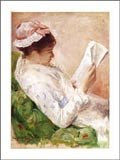
Lydia Cassatt Reading the Morning Papers
 Mary Cassatt is one of my guiding angels. Her paintings of women writing letters, drinking tea, reading, and doing needlework illuminate a life I often imagine for myself - a life surrounded by quiet beauty and the leisure to appreciate it.
Harriet Scott Chessman, the author of Lydia Cassatt Reading the Morning Papers, has gone beyond the escapist dream by bringing the reader into the life of Lydia Cassatt, the frail older sister who posed for many of Mary Cassatt's best-known paintings. "I have thought, imagined, and dreamt my way into her world," says the author. The narrative wanders as Lydia poses, musing as she holds up a teacup for hours or reads a newspaper. Lydia remembers the young man she once loved, the images she saw through her dead brother's telescope, the great artists she has known (Degas, Pissarro, Renoir), and her mother's sense of betrayal when Mary sells portraits of family members.
"Who is going to care about such pictures as much as Mary's own family?" asks Mother Cassatt. Lydia understands the core of Mary's art - how she works for hours to capture the image, gesture, and illumination of one moment, how beloved and iconic these paintings will become.
Lydia does not always understand what Mary sees, and especially not what Mary see is her, but she cherishes the gift that her sister has given her by using her image as the public face of Mary's genius.
Mary Cassatt creates the five paintings that comprise the narrative after Lydia is diagnosed with Bright's disease, inevitably fatal in the nineteenth century. Lydia's disease, her helplessness and agony, often delays the progression of the paintings. It does not affect the bond between Lydia and her sister, whose love and care seem to bathe Lydia's suffering in the rosy, caressing light in the portraits. Even Degas, whose brusque and sarcastic manner often upsets Mary, seems to become a more caring, softer presence as Lydia's life ebbs.
Chessman portrays the details of Lydia's disease and decline in prose quite blunt. One does not have to imagine the pain or embarassment of these symptoms; the prose leaves little room for imagination. However, Lydia is neither diminished by her disease nor severed from her essence. She retains the ability to observe, analyze, and understand her sister's vision and her own joy to have been a part of Mary's art.
At the end of her life, Lydia's deepest imaginings buoy her: "To live in that world you made... that creamy world of no difficulty, no blood... a life like a shell curling in on itself, glistening and clean on the sand, rolled in salt water, rolled and rolled, spent and spending." This book allows the reader to bask in both worlds - the world illumined by the magic captor of light, and the world in which we observe the mundane details behind the illusion.
Chessman has written a seamless and welcome glimpse of these worlds. Don't miss it.
Pride and Prejudice and Romeo and Juliet and Lily
I'm sipping some Adagio plum tea and contemplating how I feel about this book. The title of the blog entry says it all - except that it probably should say "Juliet and Juliet," since the eternal love in this book is between Lily and Snow Flower.
Why Pride and Prejudice? Because both ruled and warped the Chinese lives -- especially their inner lives. The historian and social observer in me recognizes that conditions in those times were difficult, sometimes brutal, and a more relaxed society might not have been able to dominate the elements or survived. Still. The physical and emotional claudrophobia that ruled the society were soul-deadening.
It occurs to me that the rigidity, ritual, and rigor of the lives of the Chinese women, and the rules that guarranteed men's absolute power over women, eliminated the possibility that men could be loved. They could be admired, they could be venerated, and they could be feared, but they could not be loved as human beings. Not one man in this book is loved. Boys are loved - but not even boys who might be less than strong and commanding. Much as I abhor and pity the lives of the women, I have to wonder how the men survived without any outlet whatsoever for their anima.
Some women found ways to love each other, although even those relationships were governed by commerce and their families' desire for status. The love of women, and the nu shu language women developed to express that love, were true miracles in that society. As always, I am awed by the strength and adaptability of women. Despite their differences, despite misunderstandings and secrets, Lily and Snow Flower were soulmates and sisters, made more beautiful and powerful by their love.
Lisa See has written an amazing book. That's all I can say. Amazing.
Why Pride and Prejudice? Because both ruled and warped the Chinese lives -- especially their inner lives. The historian and social observer in me recognizes that conditions in those times were difficult, sometimes brutal, and a more relaxed society might not have been able to dominate the elements or survived. Still. The physical and emotional claudrophobia that ruled the society were soul-deadening.
It occurs to me that the rigidity, ritual, and rigor of the lives of the Chinese women, and the rules that guarranteed men's absolute power over women, eliminated the possibility that men could be loved. They could be admired, they could be venerated, and they could be feared, but they could not be loved as human beings. Not one man in this book is loved. Boys are loved - but not even boys who might be less than strong and commanding. Much as I abhor and pity the lives of the women, I have to wonder how the men survived without any outlet whatsoever for their anima.
Some women found ways to love each other, although even those relationships were governed by commerce and their families' desire for status. The love of women, and the nu shu language women developed to express that love, were true miracles in that society. As always, I am awed by the strength and adaptability of women. Despite their differences, despite misunderstandings and secrets, Lily and Snow Flower were soulmates and sisters, made more beautiful and powerful by their love.
Lisa See has written an amazing book. That's all I can say. Amazing.
Tea you could trot a mouse on ; and, Snow Flower
I love PG Tips. I'm drinking some right now. It you're not careful, it can brew into "tea you could trot a mouse on," in the words of M.F.K. Fisher. (I've always loved that image. If I were artistic, I'd cross stitch a mouse dancing across a cup of tea!)

My next book is going to be Lisa See's Snow Flower and the Secret Fan (for a reading challenge). I'm eager to read about nu shu. According to the author's note, "It is believed that nu shu, the secret-code writing used by women in a remote area of southern Hunan province - developed a thousand years ago. It appears to be the only written language in the world to have been created by women exclusively for their own use." Lisa See's website has much more information, and photographs of women who still use and teach the language.
I'm not fond of Chinese tea, so I'm afraid I will not be drinking it. However, apricots are grown in China, and I have two types of Indian tea with apricot flavoring, so my sipping will be somewhat authentic.
(No, I don't think one's tea has to match one's book. However, a friend at work commented yesterday that the envelope for my tea [Twinings Darjeeling] matched my blouse. Hmmm.)
My next book is going to be Lisa See's Snow Flower and the Secret Fan (for a reading challenge). I'm eager to read about nu shu. According to the author's note, "It is believed that nu shu, the secret-code writing used by women in a remote area of southern Hunan province - developed a thousand years ago. It appears to be the only written language in the world to have been created by women exclusively for their own use." Lisa See's website has much more information, and photographs of women who still use and teach the language.
I'm not fond of Chinese tea, so I'm afraid I will not be drinking it. However, apricots are grown in China, and I have two types of Indian tea with apricot flavoring, so my sipping will be somewhat authentic.
(No, I don't think one's tea has to match one's book. However, a friend at work commented yesterday that the envelope for my tea [Twinings Darjeeling] matched my blouse. Hmmm.)
Lisa See - Snow Flower and the Secret Fan
Halfway through, and I realize that I am reading through a kaleidoscope of cultural personae. The thoroughly modern American woman reads a tale of a patriarchal society that expresses its disdain for women (except as sexual objects or, pardon the expression, breeders of sons) through brutality. The pain is inflicted on women by women, footbinding (hideously and graphically described) being the most obvious example, and abuse by mothers-in-law being more subtle. The second-generation daughter of Ukrainian and White Russian Jews relates to some of the rituals (food, certainly, and using arcana to support matchmaking). The literary woman delights in vivid and sensual writing, real characters, and the powerful evoking of place.
All that aside, the love story between the two young women, Lily and Snow Flower, is extraordinary. So few Chinese women of the time were allowed to develop a lifelong friendship, a sisterhood. How lightly we take our friendships compared to these women! And how lightly we take our relatively-recent ability to choose the paths of our lives.
Also, how nonchalant we are with our literacy. The special, secret language developed amongst Chinese women, nu shu, was a type of rebellion against the isolation that was required of them. It could express poetic sentiments, or pleas for pity, and it was unreadable by men.
I probably will finish this book tomorrow - it's an amazing read. Just amazing.
All that aside, the love story between the two young women, Lily and Snow Flower, is extraordinary. So few Chinese women of the time were allowed to develop a lifelong friendship, a sisterhood. How lightly we take our friendships compared to these women! And how lightly we take our relatively-recent ability to choose the paths of our lives.
Also, how nonchalant we are with our literacy. The special, secret language developed amongst Chinese women, nu shu, was a type of rebellion against the isolation that was required of them. It could express poetic sentiments, or pleas for pity, and it was unreadable by men.
I probably will finish this book tomorrow - it's an amazing read. Just amazing.
Subscribe to:
Posts (Atom)