5.16.2014

The end of innocence

My rating: 5 of 5 stars
Startling and powerful, this novel examines opposing forces during and after the first World War, with conflicts that are deeply personal as well as political. Harvard sets the stage for Helen, the Americn daughter of a conservative scholar and an activist mother, to meet Wils and Riley,  German poets and cousins, whose German and British ancestries land them on opposing sides in the European trenches. Campus politics echo the intense jingoism and violence of the time as the war intensifies overseas, with students acting on these deep prejudices and going to fight even before the United States is officially in the war.

Helen and Wils are soulmates in poetry and temperament, but poetry can not keep the war from ripping their lives apart.  Each character, major or minor, fights a war against modernism, or prejudice, or the status of women. Each conflict has consequences that are defined and defied during the war, and after.

I was shocked by an afterword: the author was inspired to write the book by a very real plaque in Harvard's Memorial Church, one that exemplifies the incoherence of society's response to war heroes, alive or dead.

Highly, highly recommended.

I received this book as an ARC from NetGalley. This is a fair review.


3.21.2014

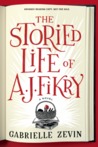
The Storied Life of A. J. Fikry

The Storied Life of A. J. FikryThe Storied Life of A. J. Fikry by Gabrielle Zevin
My rating: 5 of 5 stars

When this novel begins, the odds are against A.J. Fikrey's chances of happiness. He is widowed, having lost his wife in an accident when she drove an author home after an appearance at A.J.'s bookstore on Alice Island. He should have been driving, he thinks, but he can't drive; he has absence seizures. One plate of hurled vindaloo changes everything: when he wakes up after a binge, it has been cleaned up, but his prized copy of Tamerlane has been purloined.

Absence is a key trope in this story. The philandering husband of Ismay, A.J.'s sister-in-law, is often absent. His longtime friend, a publisher's representative, has died. He has decided to drink until he and his store are gone, too.

But - one almost-Christmas day, there is a sudden presence: an abandoned toddler girl, Maya, with a note pinned to her Elmo doll saying that her mother hopes the child will grow up to be a reader. "Funny world, right?" muses Lambiase, the police officer. "Someone steals a book from you; someone else leaves you a baby."

A.J. does not believe in fate, but he does believe in responsibility. He shocks everyone by deciding to adopt Maya. The social worker shocks herself by agreeing to the adoption, reasoning that she always loved orphan stories like Anne of Green Gables. Ismay, Lambiase, Amelia (the new publisher's rep), and the townspeople soon coalesce around the widower and the preternatually-verbal little girl, who tells A.J. she loves him after he sings "99 Luftballons" during her baths.  "I warned her about giving love that hasn't yet been earned," he says, "but honestly, I think it's the influence of that insidious Elmo."

Maya thrives in the bookstore, which also thrives as her new father adds children's books, books for the women's discussion group (Bel Canto, after he runs out of books with the word "wife" in the title), and a new group for Lambiase and his police friends. A bottle of Purell sits on the counter ("please disinfect before handling the infanta"), and Maya sits on the floor, learning to read and write. Love has appeared where it was least expected.

Each chapter is introduced by A.J., who loves short stories and has written an appreciation of some of the most elegant of the genre. (If only there were an anthology of these stories, to deepen the reader's appreciation for the elegance of this book!) The theme or circumstance of each story, including selections such as "A Perfect Day for Bananafish" (Salinger) and "What Feels Like the World" by Richard Bausch) is mirrored in the storyline. ("A Diamond As Big As the Ritz" is a favorite, but not The Great Gatsby, which A.J. thinks was "overgroomed... like a garden topiary.")

What began as absence leads to happiness. A.J. expresses his gratitude when he "closes his eyes and thanks whomever, the higher power, with all his porcupine heart." So will the reader, who should remember that nothing in well-plotted fiction is accidental. Pay attention. It will be worth it.

I received a galley of this book from NetGalley. This is a fair review.


View all my reviews

3.17.2014

Guidebook to Murder

Guidebook to MurderGuidebook to Murder by Lynn Cahoon


Quaint, pretty South Cove, California, is home to Jill Gardner, a former lawyer who has found her bliss in running a bookstore-café, Coffee, Books, and More. When she was a newcomer in town, octogenarian Miss Emily was her first friend, offering iced tea and a sympathetic ear. Now the town is threatening to knock down Miss Emily's ramshackle house to build sleek condos. Jill goes to see her friend and to mow her lawn, only to find the old woman dead in her bed, with a teacup and a Regency romance on the nightstand. Only faint marks on her neck hint that she didn't die of natural causes.

As the plot unfolds, many characters present themselves as possible suspects, including disgruntled distant relatives and a would-be land developer whose trophy wife's dog bites Jill in her own café. Miss Emily and her property prove to have had secrets that could have inspired homicide. Add the sudden disappearance of Jill's friend Amy, whose presence on the job at Town Hall could have obstructed some of the less savory plans for the old house, and you have a storyline that keeps you reading, wondering, and hoping.

Often, the first of a proposed cozy series is stuffed with backstory and explication. I found myself wishing for more early detail about Miss Emily than her protective outburst against a teen who mowed down her fairy ring, and some details about the town itself from the book that one of the suspects purchases from Jill. Perhaps the author will be more generous about the town and its residents as the series progresses.

Three stars: I guessed the perp too soon, I disliked the thankfully-brief appearance of a faux gypsy, and lack of backstory. Kudos, however, for the Oxford comma in the name of Jill's café!

I received a free galley of this book from NetGalley. This is a fair reivew.


View all my reviews

3.13.2014

The Memory Book

The Memory BookThe Memory Book by Rowan Coleman
My rating: 3 of 5 stars

The blank book is bound in red leather, and filled with textured paper that seems to "chime against the tip of a pen." The book - Claire's memory book - was bought by Claire's husband Greg on the advice of a counselor who thought it would be good therapy for her to write down the memories that her early Alzheimer's has begun to steal.

Four characters fill the book with narratives. Ruth, Claire's mother, writes about going on holiday with her daughter shortly after her own husband died of the same disease now devastating her daughter. Claire chronicles her deterioration, the unexpected joy of marrying Greg when her daughter Caitlin was a teenager, getting lost in the park and in time as the disease progresses. She worries that her three-year-old daughter, Esther, will forget her and will never know her love. Caitlin, pregnant and dropped-out of college, writes of her determination to exclude the father of her unborn baby from her life, unaware (at first) that she is about to repeat a decision that Claire had made - and now regrets. Greg writes of the unexpected joy he felt when he learned that he was to become a father.

Who are we if our memories are gone? Can you love if the people you loved are now strangers, or if you are no longer moored in time and space? The narrative moves forward and back through the pages of the memory book, and alternating chapters told from each character's point of view. Caitlin decides to follow her mother's advice and find her father, whom she had thought abandoned her. Will he welcome her? See himself in her? Love her? Claire takes pleasure in becoming friends with a man she meets in a cafe because he sees her purely as herself, not as a woman whose personhood is seeping away. These are affecting and sympathetic characters. The reader will care.

The literary device of a memory book is appealing, but there is so little deviation in tone amongst the writings and the alternating chapters that it begins to be a distraction. This is especially true of the chapters and pages by Claire. The woman whose mind is drifting into chaos, who can no longer read a picture book to Esther, and who plots gleeful, childish escapades with her three-year-old simply can not be writing long, nuanced commentaries about identity, emboli, and Jane Eyre. It simply is not believable.

Recommended, with reservations.

I received a copy of this book from NetGalley. This is an honest review.


View all my reviews

3.08.2014

Murder and Mendelssohn

Murder and Mendelssohn (Phryne Fisher #20)Murder and Mendelssohn by Kerry Greenwood
My rating: 4 of 5 stars

What a romp! Miss Phryne Fisher is the heroine of this mystery, twentieth in a series that has some parallels to the Maisie Dobbs mysteries. Both sleuths served in World War I as medical personnel, experience painful flashbacks from the carnage they saw, and call upon contacts from their war experience to help them solve crimes. But where Maisie is thoughtful, philosophical, modest, and faithful, Phryne is sophisticated witty, wealthy, and, well, easy.

Aristocratic Phryne surrounds herself with luxury, an adoring staff, brilliant adopted children, and lovers. One daughter is so clever that she "lives on tea and pencils." The other is preparing to be a chef under the tutelage of Mrs. Butler, who can whip up a feast in no time while her husband drinks tea so strong it could dye stockings. The household includes a sleek black cat, but Phryne, with her sleek black bob, green eyes, and white teeth that snap through a croissant, may be more feline than Ember.

The mystery: who killed the choirmaster as he was prepping a herd of randy and rowdy young volunteers to sing Mendelssohn's "Elijah"? Honestly, who cares? One character calls Mendelssohn's work "the musical equivalent of fairy dust." The dead conductor was loathed by all for his general boorishness and for being a "hands pig" - a groper. All agree that "he really got on someone's quince."

The young men and women couple and part, as do older men and men, while  Phryne renews an affair with a beloved man whose usual preference is men(and who is in love with a violet-eyed intellectual). Unrequited love is soon requited. Phryne takes it all in with eyes so flinty that anyone else's would garner the equivalent of "the hardness of fudge" on a Mohr scale.

The mystery? It's solved. Minuets and randy madrigals are performed. All's well that ends well.

Why only 4 stars? Because there were so many choristers that I could not keep them sorted out, because I guessed the murderer before eighty pages had passed, and because I have a low tolerance for violet-eyed angels who bedazzle with talk of Chebyshev polynomials. The book is fun to read. Go for it! After all, if the author begins by acknowledging the services of a "Duty Wombat," you know you're going to a good party.

I received this book from Net Galley. This is an honest review.


View all my reviews

2.24.2014

White Magic Five & Dime

The White Magic Five & Dime (A Tarot Mystery)The White Magic Five & Dime by Steve Hockensmith
My rating: 4 of 5 stars

Athena Passalis, Tarot reader and con artist, has been murdered, found brutally strangled in her Arizona establishment by her teenaged assistant. Although Athena's daughter Alanis has been estranged from her mother for many years, Athena has willed everything to her, including the White Magic Five & Dime.

At first, Alanis assumes that her mother's shady dealings have caught up with her, that Tarot-reading was merely the last of her mother's many schemes to pry money from gullible souls in this Sedona-Lite town. Not all is as it seems, though, and Alanis decides to take on her mother's last career choice to help a delectable police detective find the killer.

Armed with a deck of Tarot cards and a puckish Tarot guidebook (Infinite Roads to Knowing by Miss Chance), Alanis employs imagination, intuition, and the ability to spot "tells" that she learned in her peripatetic childhood, when she, her mother, and Athena's partner comprised a travelling scam circus. Suspects are plentiful. Was it the husband of a woman whom Athena had urged to buy a herd of llamas? The family of an aged woman who had been convinced to let Athena take away her "cursed" jewelry for her own protection? A bumbling bail-bondsman who was ridiculously easy to identify after a threatening phone call?

Miss Chance's book gives Alanis the basics of Tarot meanings along with asides that appeal to her own cynicism. (As in, yes, the symbolism on the cards could seem overblown enough for a Lady Gaga video.) The Hermit, muses Miss Chance, may seem like an isolated crazy in Idaho who writes anti-government screeds in a cabin, but the card-reader still should listen and learn. Likewise the muumuu-wearing Justice, or the Wheel, which might bring treasure, or might bring a winged cow. Listen and learn...

Alanis begins to feel an unaccustomed pleasure in the life of a small town. What am I really doing here? she asks the cards. The 8 of Pentacles hints at the value of learning a useful trade that could benefit a community. Perhaps, she thinks, she could stay and use the Tarot for good instead of for scams.

Yes, Alanis solves her mother's murder. (That fact really isn't a spoiler in a cozy mystery.) The reader is in for an enjoyable beginning to a new mystery series. Recommended.  Why only 4 stars? Because this reader guessed two plot points a bit too soon. I chalk it up to the authors' need to establish the who and where, and I forgive. I'll certainly read a sequel.

I received a reader's copy of this book from NetGally. This is a fair and unbiased review.


View all my reviews

2.13.2014

Thrive

Thrive: The Third Metric to Redefining Success and Creating a Life of Well-Being, Wisdom, and WonderThrive: The Third Metric to Redefining Success and Creating a Life of Well-Being, Wisdom, and Wonder by Arianna Huffington
My rating: 2 of 5 stars

This book is a mishmash of pre- and re- digested advice about getting enough sleep, becoming mindful, meditating, and changing one's value system to honor "the third metric": a redefinition of success to include values beyond money and power.

Ms. Huffington spends many pages telling the reader to unplug from digital devices, and then spends as many pages listing and annotating apps to meditate by, unplug by, control one's multi-tasking by, or even do nothing by. **

She praises and damns social media, makes generalizations about what physicists believe about time, and makes enormous generalizations about being guided by one's intuition or inner sense of rightness.  (Note: terrorists believe in their sense of rightness, too.) Other generalizations are more annoying. Sorry, I don't buy the idea that sleep is a feminist issue, and I disagree strongly that people do not bond over moments of shared mortality. Our national experience and personal experience belie that assumption.

Much of the book is not this annoying, but so much of it is that the reader almost misses some genuine insights - such as the observation that the algorithms that govern the user's "personalized" experience at sites such as amazon.com provide a very shallow interpretation of who the user is.

Note to Arianna's editor: Metaphors work better if they're not, dare I say, counter-intuitive, or downright wrong. The iceberg did not hit the Titanic. The Titanic hit the iceberg. Just saying.

I received this book as an ARC. This is my honest review.


**Literally. As in, watch this app for 2 minutes if you want to do nothing.


View all my reviews

2.11.2014

Lost Lake

Lost LakeLost Lake by Sarah Addison Allen
My rating: 4 of 5 stars

Another lovely story from Sarah Addison Allen!

Highlights:

Lisette: a mute French woman who senses others' emotions "... slipped straight to her as if through mouse holes..."

A woman named Bulahdeen, whose grandmother used to say that old hands make the best food.

A lake described as "a dense round plop of gray-green water surrounded by trees with Spanish moss hanging from their limbs, like the long hair of ladies dipping their heads to sip from the lake."

All this, plus redemption, courage, love charms, food, and a talking alligator...


View all my reviews

1.18.2014

Beautiful Wreck

Beautiful WreckBeautiful Wreck by Larissa Brown
My rating: 5 of 5 stars

"as though we'd run out of original things to be..."

Historic reenactments are no longer hobbies for the few in 22nd-century Iceland, where all now pursue their favorite eras in costume, interacting only in the recreated past. Jen, a young linguist, brings her expertise in Old Norse language and gestures to a bold, new, fully-realized Viking longhouse scenario in a full-sensory sim "tank," where participants will be immersed in their beloved era, "minus the messy beauty of a real farm, the stink of animals and work of many hands." After they leave the tank, they will re-enter the city, where the only birds left in this dystopia are crows, and the sky glimpsed only  between tall, tall buildings.

Jen's translation of a Viking woman's diary has given her a glimpse into the reality of one farmer's wife, whose sensibility seems, to Jen, more modern than most of her time. "The sky was big today, all ice and violet," wrote this woman, who also penned a lullaby to "woods and whales and sea. Goodnight to the circle of young girls, their long braids lit by fire..."

Jen's familiarity with the language and lore gives her enough of an edge to survive when the sim tank malfunctions and flings her onto a black beach, half-in and half-out of a freezing sea, half-conscious and half-aware of the song of a whale. Rescued by two Viking men whose stinking breath shocks her ("a breakthrough in the design quality"), she begins to understand that she is not dreaming -- she truly is living the life that most of her countrymen long for. She has been transported through time.

Most of the novel takes place in that very real past, where Jen (now called Ginn) becomes a member of a clan in a longhouse ruled by a young chieftan, Heirik. His fearsome birthmark represents mystery and power to his people, but Ginn learns the facts behind the lore that has defined him. She falls deeply in love. Heirik's reluctance to love becomes clearer as Ginn's immersion in this new life becomes deeper and more dear.

The reader learns about the dynamics of the varied, gritty, loving clan members as their stories intertwine, clash, and mesh. Larissa Brown's scholarship is worn lightly. The Vikings feud, gather, and love against history and folklore, like the runes, cables, and braids of Viking design. Each character and plotline is deep and real, especially those of the the displaced, beached Ginn and the women she joins in the chores, sorrows, and dreams they share.

Readers who are fiber enthusiasts will be delighted as Ginn masters the art of the spindle from the accomplished Hildur: "she showed me how the thread was forming, how to feed the fiber, like spun sugar in my hands." Images of whiteness form the background of the story: white fleeces, like the clouds that the Norse goddess Grigg spins, the white snow that piles high outside the longhouse, the snowblooms that are harvested to make mouthwash, and the disorienting whiteout that nearly costs Ginn her life. Against this whiteness are golden vistas, green swaths, and the immense blue sky.

I was as immersed in this wonderful novel as a 22nd-century Icelander would have been in the sim tank. As a modern woman, I wanted to cut through the myths and hesitations so that the characters could live their dreams, love whom they wished, and thrive. As a modern reader, I was satisfied with the way the stories unfolded, and happy with the vivid, engrossing, well-written story. Larissa Brown has taken elements of romance, history, and science fiction, and blended them into something new, vivid, and wonderful.

(Note: I was given an ARC to review. I will definitely reread the published novel - it's that good!)


View all my reviews

3.08.2013

The Missing Ink


The Missing Ink: The Lost Art of HandwritingThe Missing Ink: The Lost Art of Handwriting by Philip Hensher
My rating: 5 of 5 stars

“Handwriting is good for you,” says Philip Hensher. “It involves us in a relationship with the written word which is sensuous, immediate, and individual.”

(The incontrovertible truth of the author’s conclusion is made so much more endearing, to me, by the nonchalant use of the Oxford comma.)

This is not an author who shies from his opinions, or from sharing his vocabulary. Haruspication! Really? Oh, Philip, how do I love thee?

The Missing Ink is a very personal amble with handwriting and pens. You get history, style, art, practice, and glances into strange places, real and virtual. How delectable to learn that there is a “gloriously mad blog” out there that teaches how to improve your penmanship by changing your menu? Or that the Prince of Wales writes long letters to various government ministries, imparting his philosophy in purple ink?

The subject of handwriting analysis yields treasures. What does one have to see to believe that the penman “would jump out of an aeroplane… and drink the homebrewed absinthe of a Serbian warlord”? (And what, I wonder, would that do to my own handwring?)

Hensler devotes an entire chapter to the pen that has been my own guilty pleasure for over half of a century: the Bic Cristal. How many of these have I used until the last of the black ink, long disappeared from view and confined only within the oh-so-solid confines of the point, finally discharges its last, perfectly-black line? I hoard them against the day that some scribbling tyrant decides these pens are no longer necessary in the corporate line.

I love to read about ink colors. Hensler says, “I am not quite convinced about writing with blue ink… It is cozy and friendly, but perhaps not very serious… Beyond [blue-black or black], we are really into exotic and faintly frightening territory.”

Were I to write to the author, I would respect his preferences, but in (almost) all other ventures, I profess a great love for the purple, the turquoise, the sepia – even the occasional oxblood.  I am, in most things, a child of the sixties.

(I do admit to having been chastised by a pen friend, once, for writing a red letter on yellow paper. Point, as it were, taken.)

Oxblood brings me back to Oxford. Yes, I love this book with all its whimsy, chattiness, and excellent punctuation. You – you know who you are – will also. I promise.


View all my reviews

3.10.2012

Maisie Dobbs

Maisie Dobbs (Maisie Dobbs, #1)Maisie Dobbs by Jacqueline Winspear
My rating: 5 of 5 stars

Somehow, I managed to read some of the later books before I read the first. This book explains a lot about the characters, especially Maurice and Billy, and how some of Maisie's techniques developed. Two good storylines, excellent writing, and an engaging introduction to a period in English history that may seem less dramatic than actual wartime, but shows the long-term effects on the military, the civilians, and the disparate socio-economic classes.

I listened to the audio in the car, and read the e-book where the audio left off at home. Gotta love technology!


View all my reviews

3.09.2012

The Night Circus

The Night CircusThe Night Circus by Erin Morgenstern
My rating: 5 of 5 stars

Reading this book was like exploring an impossibly-intricate pop-up book that had been cut by the most enchanted scherenschnitte artist who ever lived. The detail, delicacy, endlessly-fascinating characters and scenes and situations -- amazing.

You can read the plot details elsewhere. I'll add one comment: the only film director I would trust with this wonder is Jean-Pierre Jeunet, whose "Micmacs" and "Amelie" are filled with the gentle, magnetic magic this book deserves.


View all my reviews

9.14.2011

How I Killed Pluto

How I Killed Pluto and Why It Had It ComingHow I Killed Pluto and Why It Had It Coming by Mike Brown
My rating: 5 of 5 stars

Mike Brown is a fluent storyteller and a scrupulous scientist, whose insistence on a high standard of proof led to him nearly losing the credit for one of his discoveries. Who would think such skulduggery exists in the community of astronomers?


As a boy, Brown discovered his passion for planets when he noticed two moving, night after night, through the constellation Orion. "It's always hard not to feel that in some ways, for me at least, maybe the early astrologers were right: Perhaps my fate actually was determined by the position of the planets at the moment of my birth."


As he recounts the discovery of Pluto, and his own role in the wildly unpopular decision to decertify it as a planet, he describes his exploration of the cosmic ocean, wherein asteroids are "schools of minnows swimming among a pod of whales. Planets were the whales of the solar system." When the Kuiper Belt was discovered, he says, "Pluto and the Kuiper Belt were simply a previously overlooked collection of sardines swimming in a faraway sea."


The boy's interest in celestial motion grew into the man's quest to discover new objects in the relatively-unexplored area beyond Pluto. His tools ranged from an archive of photos from older telescopes that had imaged wide swaths of sky to the newest digital technology in telescopes and data manipulation.  The wider images were more likely to include artifacts from the process of creating glass plates, while the precision of digital imagery was offset by the relatively small expanse of sky that could fit in one image.


His first discovery, named Quaoar, was "a big icy nail in the coffin of Pluto as a planet." Only slightly smaller than Pluto, the chunk of icy methane was bound to be the first of many objects that would be larger than Pluto. Along the course of his discoveries he found Sedna (named for an Inuit goddess of the sea), Haumea (Hawaiian goddess of childbirth), Xena (with her satellite, Gabrielle!), and many other intriguing objects that began to fill in some of the creation story of the solar system.


He also found the aforementioned skulduggery: an Italian astronomer, who cyber-stalked his use of telescopes while he was tracking Xena, and tried to claim credit for the discovery, earning Keith Olbermann's dreaded soubriquet, "Worst Person in the World." The committee in charge of the naming conventions for new objects in the solar system were not always happy with the names he chose.  (Personally, I wish that some of his working names could have been kept. It would have been delightful to know that an object named Easterbunny hopped through the heavens.)


What is a planet? Must it be spherical? A certain size? A stint of teaching geology gave Brown a glimpse into the problems that exist in other disciplines. What is a continent? A big, coherent piece of land? How big? (In fact, he learned, some Europeans do not consider Australia a continent, Argentina teaches that North and South America are one continent, and New Zealand is on its own continental plate...)


Ultimately, Pluto, "everyone's favorite runt planet," was reclassified (along with newcomers Xena and Ceres) as a "dwarf planet." Brown calls the new rules "a slew of unscientific clutter," but agrees with the decision that continues to make Pluto lovers unhappy.


One day in 2004, he took time out from staring at large computer screens and looking for new and distant objects to look at a smaller screen: a sonogram of his daughter. "Hey," he said, "It looks like the Venera lander pictures of the surface of Venus." "You're insane," replied his wife.


"That night," he writes, "as the clock struck twelve, my five-year bet [with a colleague] came to an end. I lost the bet, but I didn't feel so bad. Instead of seeing the end of the solar system, I saw that everything was just beginning."


I loved every page of this book and recommend it to anyone who has ever looked at the night sky.


View all my reviews

7.08.2011

The secret world of slugs and snails

The Secret World of Slugs and Snails: Life in the Very Slow LaneThe Secret World of Slugs and Snails: Life in the Very Slow Lane by David George Gordon
My rating: 5 of 5 stars

Now I know...

--what a wild snail eating sounds like: "... a cross between a bastard file and a chainsaw - like something out of Evil Dead II."

-- Some snails have elaborate mating rituals that involve kissing.

-- Speculation about Cupid's arrows in Greek mythology being inspired by the "love darts" that snails shoot into each other if they go the male/female route instead of using their hermaphroditic prowess.

-- that Darwin observed another scientist's experiment in which a sickly snail and its healthy partner were placed in an ill-provided garden. The healthy snail crawled away, over a wall, into a better garden. 24 hours later, it "returned and apparently communicated the result of its successful exploration, for both then started along the same track and disappeared over the wall."

-- That David George Gordon is one of the best nature writers ever.

Did you read The Sound of a Wild Snail Eating? Read this next. Really.


View all my reviews

7.02.2011

A Jane Austen Education

A Jane Austen Education: How Six Novels Taught Me About Love, Friendship, and the Things That Really MatterA Jane Austen Education: How Six Novels Taught Me About Love, Friendship, and the Things That Really Matter by William Deresiewicz
My rating: 1 of 5 stars

Take one intellectual graduate student, force him to read  Emma, add one professor whose technique is styled as "stripping the paint off our brains," and mix in some Austen plot synopses. What do you get? In this case, you get a quasi-memoir-cum-appreciation of Jane Austen's major novels that (I believe) would make Austen wince and Oprah applaud.

Bleah.


View all my reviews